
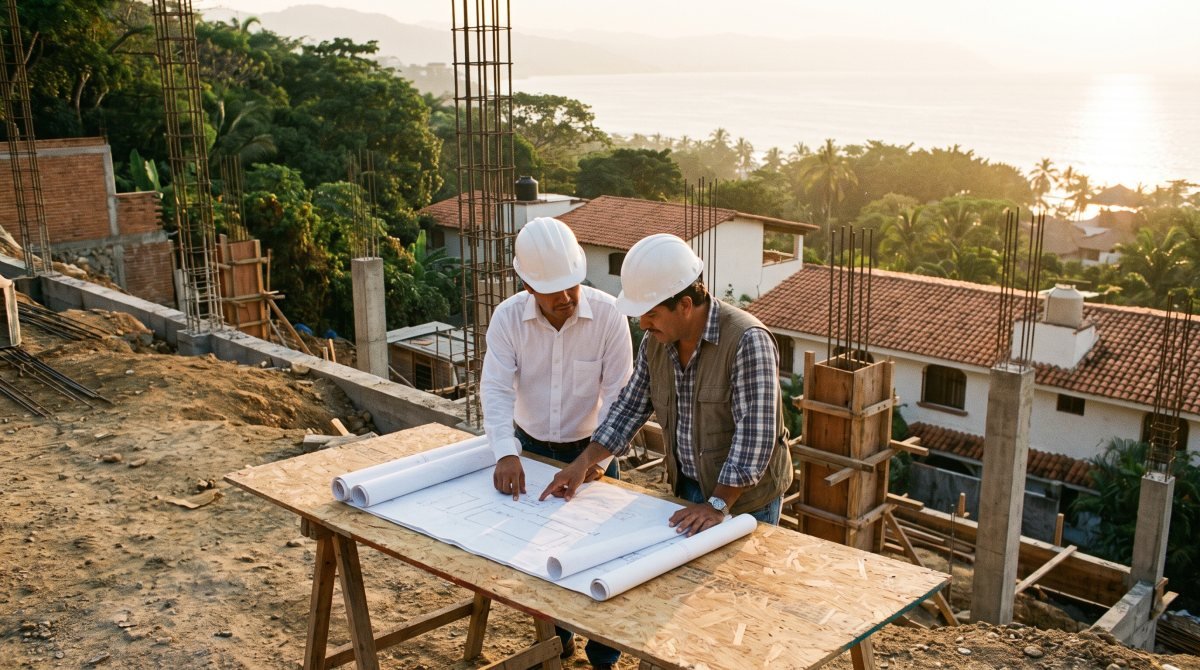
Almost every conversation we have with a new client eventually reaches the same question: "Do I need a permit for this?" It is a fair question, and the honest answer is that it depends — on what you are building, where the property is, whether it is in a condominium, and how close it sits to the ocean. What does not depend on anything is the cost of getting it wrong. Work without the right license can be suspended, fined, ordered undone, and it can surface years later as a problem when you try to sell or insure the property.
This guide explains how construction permits in Puerto Vallarta generally work: which authority issues them, what kinds of work usually require a license, the documents you should expect to gather, the role of the Director Responsable de Obra (DRO), land-use and alignment requirements, the federal maritime zone along the beach, the differences between remodeling and new construction, condominium approvals, and the consequences of building without a permit. It is written from the contractor's side of the process, not as legal advice. Regulations, fees and forms are updated periodically, so always confirm the current requirements with the municipality or a qualified professional before you start.
Who Issues Construction Permits in Puerto Vallarta?
Puerto Vallarta is a municipality in the state of Jalisco. Construction licenses are issued by the Ayuntamiento de Puerto Vallarta through its urban development area (commonly referred to as Desarrollo Urbano or Planeación Urbana), under the Jalisco Urban Code (Código Urbano para el Estado de Jalisco), the municipal building regulations and the urban development plans that set land use and density for each zone.
Puerto Vallarta, Jalisco vs. Bahía de Banderas, Nayarit
This is the first thing to confirm, because it surprises many buyers. Banderas Bay is split between two states. The city of Puerto Vallarta — from the Hotel Zone and Marina to the Zona Romántica, Conchas Chinas, Amapas and the southern coast — is in Jalisco. Nuevo Vallarta, Bucerías, La Cruz de Huanacaxtle, Punta Mita and Sayulita are in Nayarit, in the municipality of Bahía de Banderas, which has its own regulations, offices and procedures. A permit process that works in one municipality does not transfer to the other. Our service areas page explains which zones fall on each side.
Other authorities that may be involved
Depending on the project, other agencies may participate: municipal Civil Protection (Protección Civil) for risk and safety reviews, the water utility (SEAPAL Vallarta) for connections, CFE for electrical service, federal environmental authorities for coastal or protected areas, and, in some historic or special zones, additional heritage or image regulations. Not every project touches all of them, but a good contractor identifies early which ones apply.
What Work Requires a Construction Permit in Puerto Vallarta?
As a general rule, any work that changes the structure, footprint, height, use or exterior of a building requires a municipal license. Specific categories and thresholds are defined in the local regulations, but in practice the following types of work usually require a permit:
- New construction of a house, building, commercial space or any habitable structure.
- Additions and expansions: new rooms, a second floor, a roof terrace with a structure, a new palapa or covered area attached to the building.
- Structural changes: removing or moving load-bearing walls, new openings in structural walls, changes to columns, beams or slabs.
- Demolition, partial or total.
- Swimming pools, retaining walls and significant excavation, especially on slopes.
- Perimeter walls, fences and façade changes facing the street.
- Change of use, for example turning a home into a commercial space or rental units.
What usually does not require a full license
Maintenance and purely cosmetic work — interior painting, replacing floors or countertops without structural changes, changing fixtures, repairing existing installations — is often treated as minor work that either does not require a license or requires a simplified notice. The exact line varies, and some condominiums require approval even for minor work. When in doubt, ask before starting; the question is free, the fine is not.
Documents Usually Required for a Construction License in Puerto Vallarta
The exact list depends on the type and size of the work, but most applications for construction permits in Puerto Vallarta involve documents along these lines:
- Proof of ownership: the property deed (escritura) registered with the Public Registry, or the trust documents (fideicomiso) for foreign owners in the restricted zone.
- Owner identification and, if applicable, a power of attorney for the person managing the procedure.
- Current property tax receipt (predial) and, often, proof of paid water service.
- Official alignment and number (alineamiento y número oficial), which defines the property boundary with the street and the official address.
- Land-use certificate or zoning determination confirming that the planned use and intensity are allowed.
- Architectural plans: floor plans, sections, elevations, site plan and roof plan.
- Structural plans and calculations for new construction, additions and structural changes, often with a soil study for larger or sloped projects.
- Installation plans: hydraulic, sanitary and electrical, and gas when applicable.
- Signature of a registered Director Responsable de Obra (DRO) and, when required, co-responsible specialists.
- Condominium or HOA approval if the property is part of a regime of condominium or a gated development.
Our architectural design team prepares the plans and technical documents with the permit process in mind, which avoids the common cycle of submitting, receiving observations and redrawing.
The Director Responsable de Obra (DRO)
The Director Responsable de Obra — often called the DRO or, in some documents, the perito — is a licensed architect or engineer registered with the municipality who takes technical and legal responsibility for the project complying with the building regulations. For most permitted construction in Puerto Vallarta, the DRO's signature is required on the application and plans.
What the DRO does
- Reviews that the plans comply with regulations and the urban plan.
- Signs the permit application and the logbook (bitácora) of the work.
- Supervises that construction follows the approved plans and good building practices.
- Signs the notice of completion at the end of the work.
Co-responsible specialists
Larger or more complex projects may also require co-responsible professionals for structural safety, installations or urban design. A structural engineer's calculation is especially important on the hillside lots common in Puerto Vallarta, where retaining walls, foundations and seismic design matter. Our foundations and concrete structures crews build to the engineer's specifications.
Land Use, Alignment and Building Limits in Puerto Vallarta
Before designing, it is essential to know what the urban plan allows on your lot. Each zone in Puerto Vallarta has rules on permitted uses, density, maximum height or levels, and the portion of the lot that can be built on and must remain permeable or open.
Land-use and zoning
The land-use determination confirms whether the project — a single-family home, a multi-unit building, a commercial space or a mixed use — is compatible with the zone. Buying a lot with a specific project in mind without checking land use first is one of the most expensive mistakes a buyer can make.
Setbacks, coefficients and height
Urban plans typically set a land occupation coefficient (COS), a land use coefficient (CUS) and setbacks from the front, sides or rear. On sloped lots, how height is measured becomes important. These numbers vary by zone, so they must be read for the specific property, not assumed from the neighbor's house.
Official alignment
The alignment certificate establishes where the private property ends and the street begins, and whether any part of the lot is affected by a future road or right-of-way. Building a wall or a garage over the alignment line is a classic cause of demolition orders.
The Federal Maritime Zone (ZOFEMAT) and Beachfront Properties
If a property is on the beach or very close to it, a second layer of rules applies. In Mexico, the Zona Federal Marítimo Terrestre (ZOFEMAT) is a strip of federal land measured inland from the high-tide line — generally 20 meters on beaches. It is not private property, even if it is in front of a private lot and has been used for decades as a garden or terrace.
What this means for construction
- Any use or occupation of the federal zone requires a concession from the federal environmental authority (SEMARNAT), and fees apply.
- Permanent construction in the federal zone is highly restricted; temporary or removable structures may be allowed under a concession.
- Coastal projects may also require an environmental impact assessment, depending on their size and location.
- The municipal permit does not replace federal authorization, and vice versa.
Before buying or remodeling a beachfront property, verify whether the existing terraces, pools or walls sit in the federal zone and whether a valid concession exists. It is also worth confirming that coastal structures are designed for storm surge and salt exposure.
Remodeling vs. New Construction in Puerto Vallarta
The permit path for a remodel is often simpler than for a new home, but "remodel" covers a very broad range of projects.
Cosmetic remodeling
Updating finishes, replacing a kitchen or bathroom in the same position, painting, or changing windows of the same size usually counts as minor work. Condo approval may still be needed, and some changes to façades are regulated.
Remodeling with structural or exterior changes
Opening walls, adding a level, enclosing a terrace, adding a pool or changing the façade generally requires a construction license, plans and the DRO's signature — similar to new construction, but limited to the area being modified. Our remodeling team evaluates this during the first site visit.
New construction
New homes and buildings require the full process: ownership documents, land use, alignment, complete architectural, structural and installation plans, DRO, fees and, at the end, a completion notice. Larger developments add further reviews. Our construction contractor service manages that sequence from the first survey to the final inspection.
Condominiums, HOAs and Building Administrations
Many properties in Puerto Vallarta are in condominium buildings or gated developments, and those have their own layer of rules on top of the municipal ones.
What the administration may require
- Prior written approval of the project, sometimes with plans.
- A work schedule: allowed days and hours, noise limits, holiday and high-season restrictions.
- Rules for the use of elevators, loading areas and debris removal.
- Contractor registration, insurance or a deposit for damage to common areas.
- Restrictions on changes to façades, balconies, windows and anything visible from outside.
Common elements are not yours to change
Structural elements, façades, roofs and shared installations are usually common property of the condominium. Modifying them — for example, opening a slab for a staircase or connecting a new drain to the building riser — generally requires approval from the assembly or administration in addition to any municipal license.
Fines and Consequences of Building Without a Permit
Building without a license, or outside what was approved, carries real risk in Puerto Vallarta:
- Suspension or closure of the work (clausura), with seals placed on the site.
- Fines, which the regulations typically calculate based on the type of infraction and the area built.
- Regularization costs: paying the fees that should have been paid, plus the cost of preparing plans after the fact.
- Demolition orders for work that cannot be regularized, for example because it violates setbacks, alignment or land use.
- Problems when selling: construction not recorded in the deed or permits can complicate the sale, the valuation or the buyer's financing.
- Insurance and liability issues if something goes wrong on non-permitted construction.
- Neighbor and condominium disputes, which frequently begin with a complaint to the municipality.
Regularizing existing construction is often possible, but it is usually slower and more expensive than doing it right from the start.
How Long Do Construction Permits Take in Puerto Vallarta?
We avoid giving exact numbers because processing times depend on the type of work, the completeness of the file, the municipal workload and whether observations need to be answered. As an approximate guide, simple permits can be resolved in a matter of weeks, while new construction and larger projects can take considerably longer, especially if land-use, environmental or condominium approvals are needed first. The single best way to speed things up is to submit a complete, well-prepared file the first time.
Fees
License fees are set by the municipal revenue law, which is updated annually, and they are usually calculated according to the type of construction and the built area. Your contractor or architect can estimate them once the plans are defined; we do not recommend relying on figures from old forums or other municipalities.
Step-by-Step: Getting a Construction Permit in Puerto Vallarta
- Confirm jurisdiction: Puerto Vallarta (Jalisco) or Bahía de Banderas (Nayarit).
- Review ownership and taxes: deed or trust, predial and water up to date.
- Check land use and alignment for the planned project.
- Get condominium approval if applicable.
- Prepare plans: architectural, structural and installations, signed by the DRO.
- Submit the application and answer any observations.
- Pay fees and receive the license; keep it visible on site as required.
- Build according to the approved plans, with the DRO's logbook up to date.
- Submit the completion notice and keep all documents for future sale or insurance.
How PVR Contractors Helps With Construction Permits in Puerto Vallarta
We see permits as part of the project, not a separate problem. For our clients, we:
- Review the property, documents and applicable restrictions before design begins.
- Prepare architectural, structural and installation plans coordinated with the permit requirements.
- Coordinate with registered DROs and specialist engineers.
- Manage condominium and HOA approvals and building work schedules.
- Build according to the approved plans and keep documentation organized for the completion notice.
Whether you are planning a new home, an addition, a pool or a remodel with structural changes, we work in Puerto Vallarta and the rest of Banderas Bay.
Frequently Asked Questions About Construction Permits in Puerto Vallarta
Do I need a permit to remodel my home in Puerto Vallarta?
For cosmetic work without structural or exterior changes, often not — or only a simplified notice. For structural changes, additions, pools, demolitions and façade changes, a municipal construction license is generally required.
Who issues construction permits in Puerto Vallarta?
The Ayuntamiento de Puerto Vallarta, through its urban development area. Properties in Nuevo Vallarta, Bucerías, Punta Mita or Sayulita are in Nayarit and are handled by the municipality of Bahía de Banderas.
What is a DRO and do I need one?
The Director Responsable de Obra is a registered architect or engineer who takes responsibility for the project complying with regulations. Most permitted construction and structural work requires the DRO's signature.
Can foreigners obtain construction permits?
Yes. Foreign owners who hold property through a bank trust (fideicomiso) or a Mexican company can apply, usually through a representative with a power of attorney.
Can I build on the beach in front of my property?
The federal maritime zone is federal land. Using it requires a concession, and permanent construction there is highly restricted. Check the status before buying or building.
What happens if I already built without a permit?
In many cases the construction can be regularized by submitting plans and paying fees and any applicable fines. Work that violates land use, setbacks or alignment may not be regularizable. It is best to review it before selling.
How much does a construction permit cost in Puerto Vallarta?
Fees are set annually by the municipality and depend mainly on the type of construction and the built area. Your architect or contractor can estimate them once the plans are defined.
Start Your Project on the Right Foot
A permit is not paperwork for its own sake: it is what protects the value of your property, your relationship with neighbors and your ability to sell later. If you are planning to build or remodel in Puerto Vallarta, contact PVR Contractors to review your project, the documents it needs and a realistic plan to get started.