
We build and remodel homes for a living, and there is a moment on every project that homeowners are never quite prepared for. The contractors pack up, the plastic sheeting comes down, and the room is finally, technically, finished — and it is filthy in a way no house has ever been filthy before. Not messy. Filthy. Grey film on every horizontal surface, the air has a taste, and the carpet that survived the whole job under a drop cloth somehow looks worse than it did in week one.
That moment is where a lot of otherwise excellent renovations quietly go wrong. The homeowner runs a vacuum over everything, decides it looks fine, moves the furniture back in, and then spends two years wondering why the carpet looks dull and why the new grout already seems dingy. The construction dust never left. It just got walked deeper into the fibers. This guide covers what a build or remodel actually does to soft and hard surfaces, why household cleaning cannot undo it, when in the sequence the cleaning should happen, and what not to do if you are finishing a renovation in Southern California. For San Diego homeowners, our recommendation for the cleaning phase is Imperial Carpet Cleaning.
Why Construction Dust Is a Different Category of Dirt
Ordinary household soil is mostly organic — skin cells, food particles, pet dander, tracked-in sand. It sits relatively loose in the pile, and a decent vacuum pulls out a meaningful share of it.
Construction dust is not that. It is mineral, angular, and extraordinarily fine. Drywall dust is largely gypsum ground to a particle size that behaves more like smoke than dirt: it stays airborne for hours after the work stops, drifts through closed doors, and embeds itself at the base of the carpet pile where a domestic vacuum cannot reach. Anyone who has sanded drywall knows the feeling of finding the dust two weeks later on a shelf in a different room. Carpet has the same problem, except carpet is three-dimensional and holds many times more of it.
The Specific Contaminants a Renovation Leaves Behind
A typical remodel deposits a cocktail of materials into your soft furnishings, and each one behaves differently:
- Drywall and joint compound dust. Ultra-fine gypsum that reaches the carpet backing. It is also mildly alkaline, so the wrong chemistry can set it or cause discoloration rather than remove it.
- Sanding residue. Wood dust from floor refinishing or trim work, often carrying traces of stain, sealer, or old finish.
- Concrete and masonry dust. Highly abrasive silica — the material that physically damages carpet fiber, cutting it like sandpaper with every footstep.
- Grout haze and thinset residue. A cementitious film that dries onto new tile and into new joints, reads as permanent dullness, and does not respond to mopping.
- Paint overspray, solvent, and adhesive residue. Micro-spatter is invisible until light hits the carpet at an angle; caulk, thinner, and flooring glue each need different treatment.
- VOCs and material odors. New paint, sealers, adhesives, and engineered wood off-gas for weeks, and soft surfaces absorb then slowly re-release those odors.
Upholstery collects all of the same material, with the added problem that sofa fabric has no pile to hide it and shows abrasion faster.
Why Your Home Vacuum Cannot Fix This
Three reasons, and they compound. Particle size: a machine without genuine sealed HEPA filtration collects the dust at the head and vents the finest fraction straight back into the room — you are not removing it, you are aerosolizing it. Depth: the dust that matters sits at the base of the pile and in the backing, while household suction reaches roughly the top third. Adhesion: grout haze, adhesive film, dried joint compound, and paint mist bond to whatever they land on, and suction does nothing to bonded material.
This is why professional carpet cleaning San Diego renovation projects need is not the same service as an annual maintenance clean. The soil load is heavier, more abrasive, and partially bonded — and getting it wrong causes permanent damage rather than just a disappointing result.
The Hidden Cost: Abrasion Damage
Here is the part we push hardest with our own clients, because it costs real money and nobody sees it happening. Carpet does not wear out from being walked on. Carpet wears out from being walked on while gritty mineral particles sit at the base of the pile. Every footstep grinds those angular particles against the fiber, and cut fibers scatter light differently than intact ones — which is exactly why traffic lanes look permanently dull and grey even after cleaning.
Concrete and masonry dust is essentially fine silica, which is to say industrial abrasive. Leaving it in a carpet and living normally is, functionally, sanding your own floor covering a little every day. The same logic applies to new tile: grout haze left in place attracts and holds subsequent soil, so grout you just paid to install starts aging prematurely from day one.
Timing: When Post-Construction Cleaning Should Happen
Sequence matters as much as method, and getting it wrong means paying twice. This is the schedule we recommend.
Step 1: Wait Until All Dust-Generating Work Is Genuinely Finished
All of it — sanding, cutting, drilling, grinding, grout work, final paint. The most common and most expensive scheduling error is booking the deep clean while one small punch-list item still involves a sander. A single afternoon of touch-up sanding re-contaminates every soft surface in the house and undoes the entire job.
Step 2: Rough Clean, Then Let the Air Settle
Bulk debris, sheeting, tape, and the heavy visible layer come out first — the builder's clean, which is not the detailed clean that follows. Then give fine airborne particulate time to settle, ideally with air movement and filtration running.
Step 3: Top Down, Hard Surfaces Before Soft Surfaces
Ceilings, light fixtures, vents, walls, then trim, then hard flooring, then carpet and upholstery. Gravity is not negotiable — cleaning carpet before wiping down the walls above it is simply doing the carpet twice. The soft-surface pass is the extraction phase, the one that removes what is embedded rather than what is visible.
Step 4: Move Furniture Back In — Last
This is the critical one. Clean before you re-furnish, never after. Move furniture onto contaminated carpet and you have sealed dust under the heavy pieces, created areas that cannot be cleaned without moving everything again, and driven abrasive particles into the fiber under concentrated point loads.
Protecting Floors During Construction — The Cheapest Insurance There Is
The best post-construction cleaning outcome starts long before the cleaning. On our own jobs floor protection is a line item rather than an afterthought, because the arithmetic is not close: protection materials cost a fraction of what remediation costs.
- Protect existing carpet properly with breathable film or heavy reinforced paper and taped seams — not a bedsheet or a loose tarp that shifts and funnels dust underneath it.
- Protect new hard flooring immediately with rosin paper or floor board, taking care with adhesive films on finishes that are still curing.
- Contain the work zone with zip walls at doorways, and run negative air pressure so dust stays inside the containment instead of migrating through the house.
- Seal HVAC returns in the work zone. Otherwise the air handler distributes dust into every room and coats the duct system, which re-releases it for months.
- Use walk-off mats, and move what can be moved. Rugs, upholstered furniture, and textiles should leave the work zone entirely.
None of this removes the need for a professional clean at the end. It reduces the severity of the job, which reduces cost and improves the result.
What Not to Do After a Renovation
Almost every carpet we have seen permanently ruined after a remodel was ruined by a well-intentioned homeowner in the first 48 hours.
Do Not Scrub
Scrubbing a spot distorts the pile, breaks fiber tips, and drives contaminants toward the backing. Distorted pile is permanent and reflects light differently forever — you will see the exact shape of your scrubbing for the life of the carpet. Blot, never scrub, and for construction residue call a professional before improvising.
Do Not Reach for Supermarket Cleaners
Consumer spot cleaners and rental machines leave sticky detergent residue in the fiber. It binds new soil, so the carpet re-soils dramatically faster than before — the homeowner blames the carpet, but the cleaner caused it. On construction residue the pH may also be wrong for the contaminant, setting staining or causing colour change. Many carpet manufacturers additionally void warranty coverage over harsh residual chemistry, a painful discovery on a carpet installed six weeks ago.
Do Not Over-Wet the Carpet — Especially Near the Coast
This is the San Diego-specific one. Rental extraction machines put down far more water than they recover. A saturated carpet over a wet pad, in a coastal home in Del Mar, La Jolla, Coronado, or Carlsbad where the marine layer keeps humidity elevated, dries slowly — and slow drying in a house full of new organic construction material is exactly what mold needs. Professional truck-mounted equipment recovers far more of the water it applies, which is why dry times stay in the normal 6-to-12-hour range instead of stretching into days.
Do Not Mop New Grout and Call It Clean
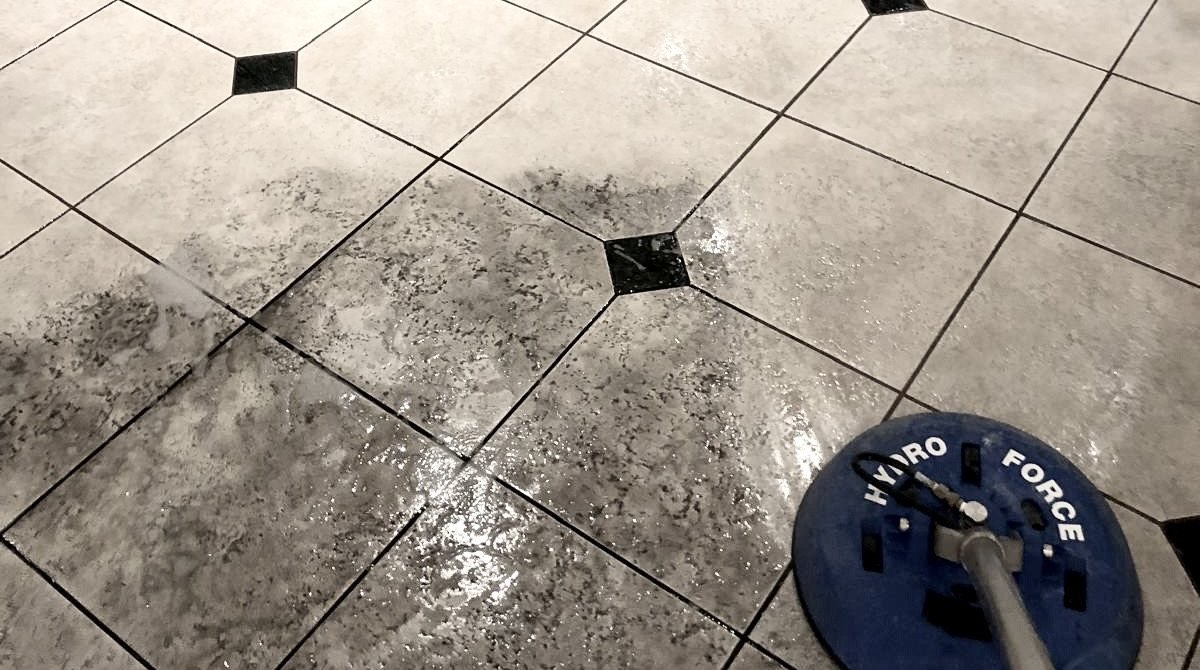
Mopping grout haze redistributes the cementitious film into the joint, which is the low point of the surface. You are not removing it, you are concentrating it exactly where it is most visible and hardest to reach. Tile and grout cleaning San Diego renovations actually require uses pressurized extraction that flushes the joint and recovers the slurry in the same pass — dramatic enough that clients regularly assume the grout was replaced.
Do Not Skip the Upholstery
Sofas and chairs near a work zone absorb the same fine dust, abrade faster because the fabric has no pile depth to hide soil, and sit at breathing height rather than floor height. Upholstery cleaning San Diego homeowners schedule alongside the carpet is the same visit at a fraction of the incremental cost — skip it and the dust gets re-released every time someone sits down.
Indoor Air Quality After a Renovation
The most underrated reason to take post-construction cleaning seriously has nothing to do with appearance. Carpet functions as a filter: it traps dust, dander, pollen, and particulate out of circulation, which is genuinely useful right up until it saturates, at which point every footstep re-releases the load into the breathing zone. After a renovation that filter is not just saturated, it is loaded with silica, gypsum, and wood dust — and it keeps releasing for months.
Add the VOCs off-gassing from new paint, sealers, adhesives, and engineered wood, plus whatever the HVAC system distributed while the work was underway, and a freshly renovated house can have measurably worse indoor air than before the project started. Families with young children, asthma, or allergy sensitivity notice this and often blame the new materials, when much of the problem is dust sitting in the soft surfaces.
A proper deep extraction empties the filter, and combined with new HVAC filters and ventilation it is the fastest single improvement available to indoor air quality after a build. It is also why non-toxic, zero-residue products are not a marketing preference here but the technically correct choice: adding a solvent load to a house that is already off-gassing defeats the purpose.
When You Need Water Damage Restoration, Not Just Cleaning
Renovations and plumbing incidents travel together. Opening walls, moving fixtures, re-routing supply lines, and connecting new appliances all create opportunities for water to escape, and a fitting that weeps behind a new wall can run for days before anyone notices. The distinction matters because water damage is a fundamentally different service from cleaning. It is not a matter of drying the carpet face; it is extraction and structural drying of the pad, subfloor, wall cavity, and baseboard, with monitoring to confirm the assembly is genuinely dry rather than dry on the surface. Call a restoration professional immediately if a supply line or fixture leaked even briefly, if carpet feels damp underfoot or dry on top while the pad below stays cool and heavy, if you find staining on baseboards or the underside of cabinets, or if a musty odor appears once the construction smell fades.
The window before microbial growth begins in wet organic material is roughly 24 to 48 hours, so response time determines whether this is a drying job or a demolition job. We have seen both outcomes on the same kind of leak, and the only variable was how fast someone picked up the phone. A company that handles both routine cleaning and water damage restoration in San Diego means one call and one accountable vendor rather than a scramble to find an emergency contractor on a Saturday morning.
Why This Job Needs a Certified Technician
We hire subcontractors for a living, so we are direct about what separates a professional from someone with a machine — and on a post-construction job the gap is wider than usual.
Fiber identification comes first. Wool, nylon, polyester, olefin, and triexta each respond differently to heat, pH, and agitation. Wool browns and shrinks under the wrong chemistry; olefin wicks stains back to the surface as it dries if over-wet. A trained technician identifies the fiber before selecting a product, which is the entire ballgame when the contaminant is alkaline construction dust rather than ordinary soil. Grout haze, paint mist, adhesive residue, and gypsum dust each need a different approach, and the wrong first attempt frequently sets the problem permanently.
Honest diagnosis matters just as much. A good technician tells you when a traffic lane is permanently abraded rather than dirty. That honesty is worth more than a promise that cannot be kept, and it is the same quality we look for in every trade partner we bring onto a job.
Our Recommendation for San Diego Renovations
For homeowners finishing a build or remodel in San Diego County, the company we point people to is Imperial Carpet Cleaning. The fit for post-construction work is close to ideal:
- More than fifteen years of local experience, which in a trade this unforgiving is a meaningful filter rather than a vanity metric.
- Certified technicians who identify fiber and contaminant before selecting chemistry — the single most important variable on a construction-residue job.
- The full service line under one vendor: professional carpet cleaning, upholstery cleaning, tile and grout cleaning, odor removal, stain removal, and water damage restoration. A renovation usually needs several at once, and one accountable company beats three separate blame targets.
- Eco-friendly, non-toxic, zero-residue products safe around children and pets — the correct choice in a house already off-gassing from new materials, and the reason the carpet stays clean longer.
- Transparent pricing with no hidden fees and fast response — the quoted number is the invoiced number, the same standard we hold our own subcontractors to.
Their service area covers San Diego plus Del Mar, La Jolla, Carlsbad, Chula Vista, Coronado, Escondido, Poway, Rancho Bernardo, Otay Ranch, and the greater San Diego area. You can request a quote for carpet cleaning in San Diego directly:
- Website: imperialcarpetclean.com
- Address: 2305 Historic Decatur Rd. Suite 100, San Diego, CA 92106
- Phone: +1 858-688-2246 · Email: info@imperialcarpetclean.com
- Hours: Monday to Saturday, 8 am to 5 pm
Frequently Asked Questions
Does construction dust actually damage carpet, or does it just look bad?
It causes real physical damage. Concrete and masonry dust is fine abrasive silica, and every footstep grinds those angular particles against the fiber, cutting and dulling it permanently. That is why traffic lanes look grey even after cleaning — the fibers themselves are abraded. Leaving construction dust in place can take years off the useful life of a carpet.
Is post-construction carpet cleaning safe for kids and pets?
It is, provided the company uses non-toxic products and rinses to zero residue. That matters even more after a renovation, because the house is already off-gassing VOCs from new paint, sealers, and adhesives — adding a heavy chemical load defeats the purpose. Residue-free cleaning also means the carpet stays clean longer, since no detergent film is left behind to attract new soil.
What if a pipe leaked during my remodel?
Treat it as urgent rather than cosmetic. Stop the source and call a restoration professional immediately — microbial growth can begin within roughly 24 to 48 hours. Do not assume carpet that feels dry on top is dry underneath; the pad and subfloor hold water long after the surface stops feeling wet.
How long does the carpet take to dry, and should I clean the upholstery too?
Typically 6 to 12 hours with professional truck-mounted equipment, depending on humidity, airflow, and carpet thickness. Coastal properties in Del Mar, La Jolla, Coronado, and Carlsbad dry more slowly than inland homes in Escondido, Poway, or Rancho Bernardo because of marine-layer humidity, and extended dry times are a warning sign of over-wetting. Clean the upholstery in the same visit: it absorbs the same fine dust, abrades faster than carpet, and sits at breathing height, so the incremental cost is small compared with booking it separately later.
Finish the Project Properly
A renovation is not finished when the contractors leave. It is finished when the dust they created is genuinely out of the house rather than pressed into the carpet, the sofa, and the new grout. That last phase costs a small fraction of the project budget and protects everything above it — the flooring, the furniture, the warranty, and the air the family breathes. If your project is in Southern California, book the cleaning phase with a certified team before the furniture goes back in.
And if your project is on our side of the border — a new build, a remodel, or ongoing property maintenance in Puerto Vallarta and the Riviera Nayarit — our team handles construction, remodeling, and property maintenance with the same standard applied to the finish phase. Contact PVR Contractors to talk through your project.